
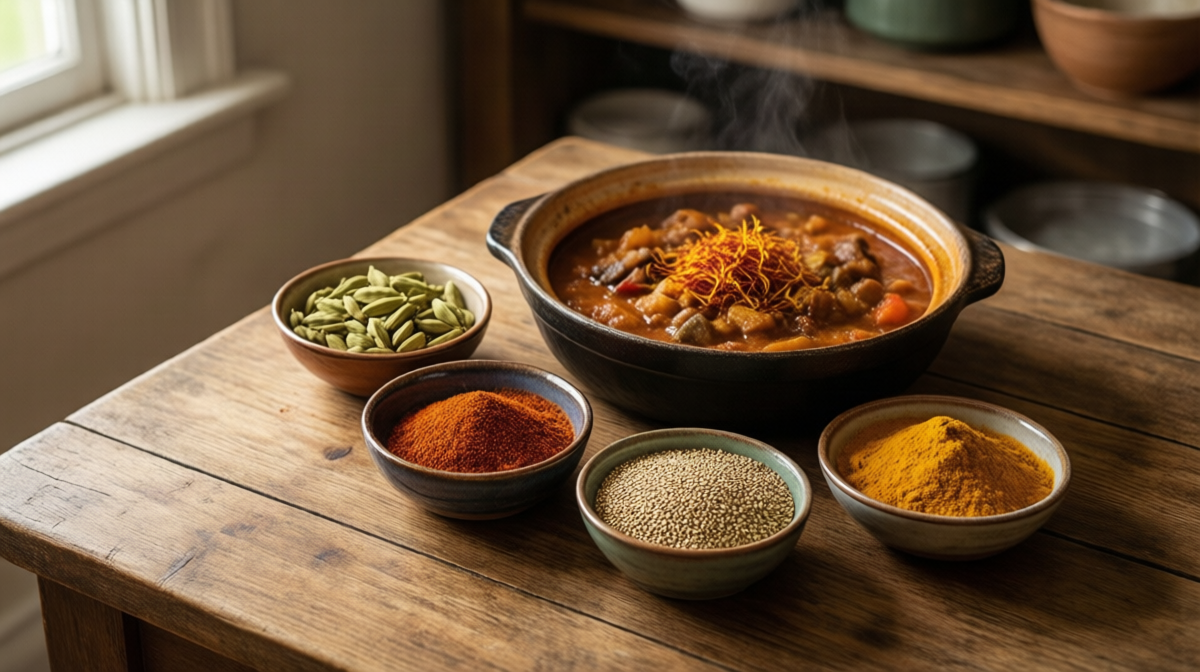
There are days when the culinary routine plays a nasty trick on us: we open the spice drawer, look at the tin of paprika and cumin, close the drawer and end up using the same thing as always. As a mother who cooks every day for her family with Umami Cook, I know well that sometimes the hardest part is not cooking, but breaking that circle of monotony without spending hours in the kitchen.
Today I want to talk to you about five spices that perhaps you have forgotten at the back of the cupboard or that you have never dared to buy. They are discreet, inexpensive ingredients with incredible transformative power. It’s not about cooking exotic food every day, but using these tools to give your home stews a subtle and delicious turn.
1. Cardamom: the aroma that awakens the kitchen
Cardamom is deceptively delicate spice. We often associate it only with Scandinavian coffee or Arab sweets, but in savory dishes it is an overlooked gem. Its black seeds have an aromatic green interior that releases citrusy and slightly eucalyptus notes.
In my kitchen, I use green cardamom in chickpea stews with spinach or chicken stews with root vegetables. The trick is to crush the whole pods (without peeling) at the beginning of the sofrito or add the ground seeds just before turning off the heat. A couple of pods in a lentil stew with pork or potatoes completely changes the perception of the dish: it adds freshness and complexity without anyone knowing exactly what it is.
2. Saffron threads: accessible luxury and golden color
Saffron has a bad reputation for being too expensive or difficult to use, but as a practical mother I tell you: buy it in threads and use it with care. You don’t need a whole dish to enjoy it; a small pinch is enough.
The secret of saffron lies not only in its golden color that dyes rice or fish stews, but in its ability to enhance the deep flavor of broths. I almost always use it in vegetable rice or cod stews. The fail-safe technique is to crush a few threads in a mortar with a pinch of salt and add a splash of hot water to release the aroma before incorporating it into the stew. That way you ensure that every drop of the dish has its essence.
3. Ras el Hanout: the blend that never fails
Ras el hanout is a Moroccan blend that literally means “the best of the shop”. Each family has its version, but it usually includes cinnamon, turmeric, ginger, clove, nutmeg and pepper.
It is perfect for those who want an exotic result without having to look for ten different spices. I use it as an aromatic base in lamb or chicken stews with raisins and almonds. I also love adding a teaspoon to lentil stews with spinach to give that sweet-sour touch that works so well in home cooking.
4. Sumac: the citrusy touch without acidity
Sumac is a dark red powder made from dried and ground berries. Its flavor is intensely sour, similar to lemon but with a smoky and earthy touch. It is a spice I forget too much because I am too lazy to squeeze lemon on top of everything.
I use it as a finisher in chickpea stews, vegetable stews or even on roasted potatoes before serving. Sumac is not cooked; it is added at the end to maintain its freshness and vibrant color. It’s Carmen’s trick to prevent the stew from going flat after hours on low heat.
5. Mild curry: your pantry ally
Mild curry (madras or mild type) is an Indian blend that combines turmeric, coriander, cumin and sweet paprika in balanced proportions. It is not spicy, but warm and earthy.
It is the spice I use most to give a twist to vegetable stews: eggplants, pumpkins or green beans. The key is to toast the curry gently in oil before adding the vegetables; this activates its essential oils and intensifies the flavor without bitterness.
Practical integration into your daily kitchen
You don’t need to buy them all at once. Choose one that catches your eye and try it in a simple stew: rice, lentils or chicken. Repetition creates consistency and confidence. Also, remember that spices should be stored in opaque and dry jars so as not to lose their aroma.
Sources
- AESAN (Agencia Española de Seguridad Alimentaria y Nutrición): Information on condiments and spices.
- Harvard T.H. Chan School of Public Health: Spices and Herbs for Nutrition.
- #especias
- #gastroonomía
- #guiso
- #sabores
- #umami