
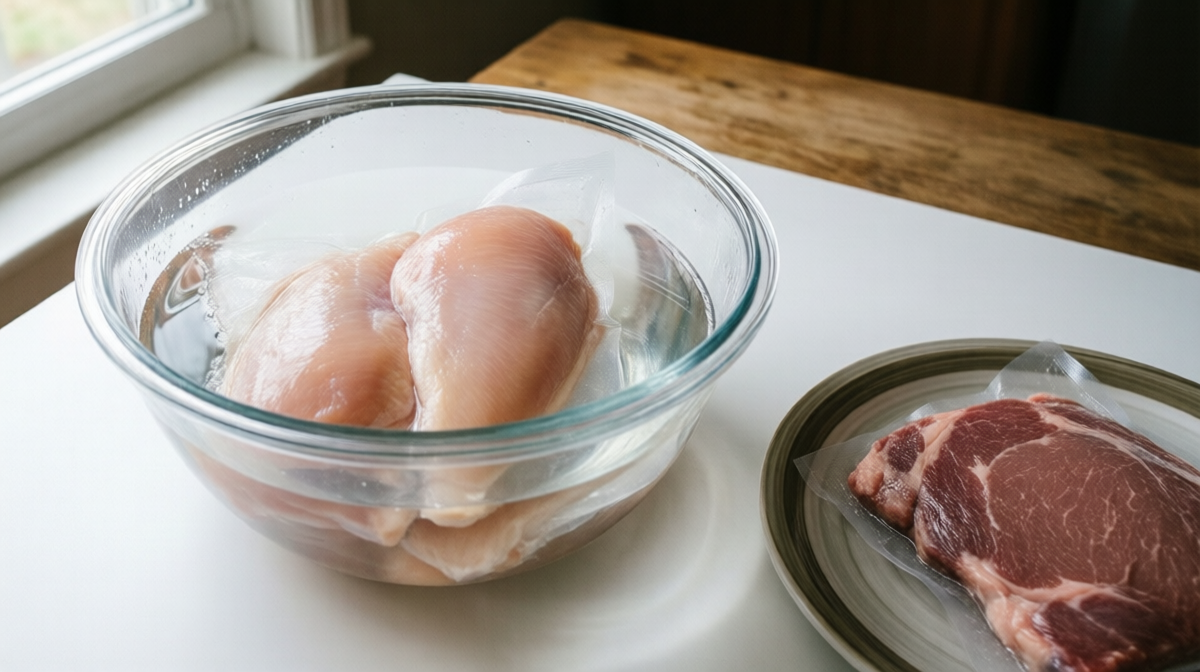
As a mother who cooks every day, I have made the mistake of leaving meat or fish forgotten in the fridge for two full days waiting for it to thaw. The result is usually heartbreaking: a gummy texture, lost juiciness, and that “defrosted” flavor that ruins even the best sofrito.
Today I will explain the cold water trick compared to the traditional fridge method so you never lose quality in your food again. It is a simple change that transforms the final texture of your dishes.
The Problem with Slow Defrosting in the Fridge
Defrosting in the fridge is safe and recommended by health authorities, but it has a practical flaw: time. When food thaws slowly at 4°C, the ice crystals that formed when freezing create small cavities. The released water does not reabsorb well into the food’s protein matrix.
In red meats and white fish, this means the natural juice drains out before you even start cooking. The result is a drier, more fibrous protein. Furthermore, if you defrost a salmon fillet or a tenderloin in the fridge for 24 hours, you risk the surface oxidizing slightly or absorbing odors from other foods.
The Science of Cold Water: Why It Preserves Texture Better
The cold water trick works because it accelerates heat transfer. By submerging the food (well-sealed in a waterproof bag) in cold water, the temperature difference between the water and the inside of the food is greater than in the cold air of the fridge.
This allows ice crystals to melt faster and more uniformly. The surrounding water carries heat constantly, preventing the outer layers from getting too warm while the center remains frozen.
The result is that proteins do not contract or denature prematurely. The meat maintains its cellular structure intact and retains its natural juices until the moment of cooking. It is a subtle detail, but in a family dinner, it makes the difference between a dry dish and a juicy one.
How to Apply the Trick Step by Step (Without Risks)
For this method to work and be safe, follow these strict steps:
- Seal Hermetically: Use a freezer bag with a ziplock closure. Remove as much air as possible before closing. If water comes into direct contact with the meat, you will lose flavor and texture.
- Use Cold Water, Never Warm: The water must be at room temperature or slightly cold. Warm or hot water will activate bacteria on the surface of the food while the center remains frozen.
- Change the Water Every 30 Minutes: This is crucial. As the water heats up from contact with the food, it loses its heat transfer capacity. Changing it keeps the process efficient and safe.
- Estimated Time: A thin fillet (1-2 cm) defrosts in 30-45 minutes. A thick piece or a whole chicken piece can take between 1 and 2 hours.
Quick Comparison: Fridge vs Cold Water
| Method | Time | Final Texture | Safety |
|---|---|---|---|
| Fridge (4°C) | 12-24h | May lose juiciness | Very High |
| Cold Water (changed) | 30min-2h | Preserves texture and flavor | High if water is changed |
When to Use Each Method: My Practical Rule
As Carmen, I tell you that I don’t always have time to wait. But I also don’t want to risk my family’s health.
Use cold water when:
- You are in a hurry (less than 2 hours).
- You cook white fish or thin fillets.
- You want maximum juiciness in lean meats.
Use the fridge when:
- You plan ahead.
- You defrost very large pieces (like a whole turkey).
- You prefer absolute safety without supervision.
Reliable Sources for Your Daily Kitchen
The basis of these tips is backed by official bodies that study microbiology and food safety. It is not about opinions, but proven physical and biological principles.
To deepen the risks of improper defrosting, consult the guidelines from AESAN (Spanish Agency for Food Safety and Nutrition) on safe handling of frozen foods. Additionally, the WHO offers global guidelines on how to avoid cross-contamination during meal preparation.
Remember: a good defrosting is the first step to a successful family dinner. Do not underestimate the power of cold water.
- #descongelacion
- #textura-alimentos
- #seguridad-alimentaria
- #truco-cocina