
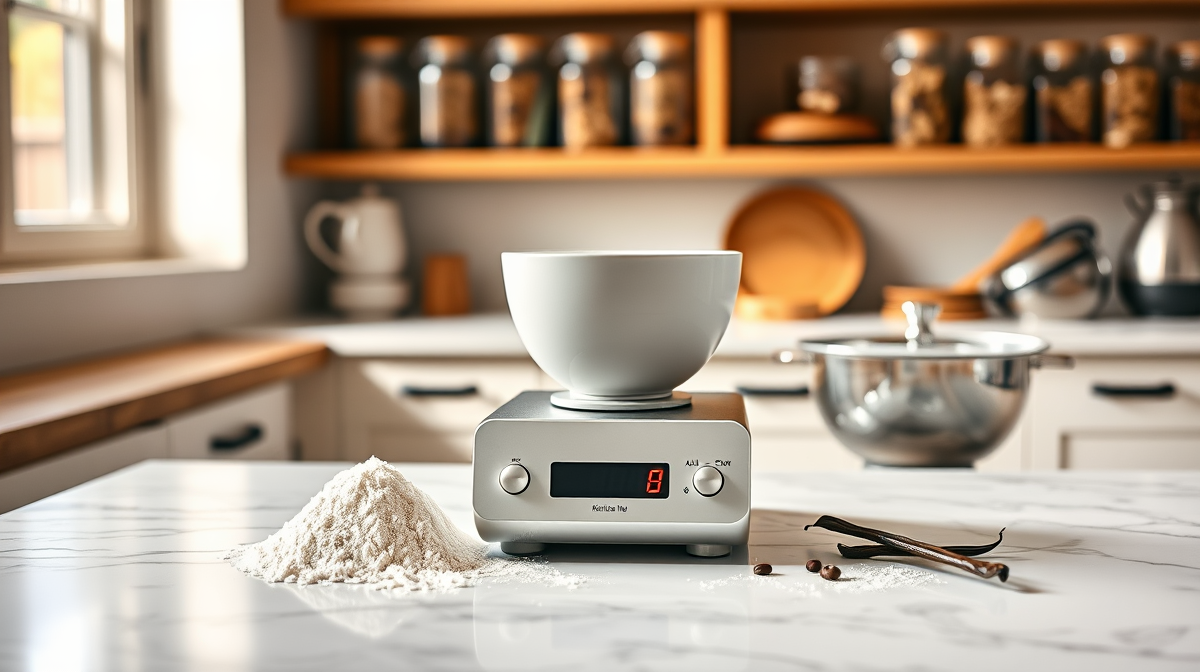
Why your eyes lie to you in the kitchen
Cooking by eye has its charm: it is intuitive, fast, and allows you to improvise with what is in the fridge. But when the goal is repeatability, the eye becomes your number one enemy. Two cups of flour can weigh 120 grams if sifted gently or 180 grams if packed without realizing it. Ambient humidity, brand variations, or even how tightly raisins are pressed into a bowl completely change the proportion of ingredients. In my daily experience, most recipes that “fail” are not to blame for the original formula, but for inconsistent measurement. Learning to weigh is not an act of perfectionism, but respect for the ingredients and your own time. Moreover, household measurements vary by country and culture; what a recipe indicates as “one cup” may be a completely different standard from what we have in our pantry. Variability is not a flaw in your kitchen, but a limitation of visual estimation that accumulates with every step you take.
Precision as the foundation of consistency
A digital kitchen scale eliminates human variability. By standardizing quantities, you ensure that bread rises the same way three days in a row, that dressings have the exact balance of acidity and sweetness, and that protein and carbohydrate proportions are predictable. This is especially useful when adjusting flavors or adapting recipes for smaller or larger families. The key lies in the tare function: you weigh the empty container, set it to zero, and add the ingredient directly. This avoids mental calculations and unnecessary waste. Additionally, many modern scales allow switching between grams, ounces, and milliliters, making it easier to work with international recipes without losing precision. Consistency does not kill creativity; on the contrary, it gives you the confidence to experiment knowing exactly which variable you are modifying. When you know the result depends on the exact proportion, you stop blaming the oven or the heat and start adjusting with clear reasoning.
Common mistakes with the scale (and how I fix them)
At first, the scale can seem deceptive. One of the most common errors is placing the bowl directly on the glass surface without a flat, stable base. The weight distributes poorly and the reading is wrong. I always use a wooden surface or an anti-slip silicone base. Another frequent mistake is weighing wet ingredients like yogurt or honey in the same dry container; residual moisture alters the weight and sticks the ingredient. For this, I weigh the honey on parchment or in a small separate bowl, then transfer it. It is also vital to keep dust off the sensors: a gentle wipe with a dry cloth every time I use flour or sugar prevents phantom readings. And watch out for calibration: if the scale shows absurd values with a known weight, adjust it or return it. It is not about buying the most expensive model, but one with 1-gram precision and a screen readable under kitchen lighting. Practice weighing water: 100 ml should give exactly 100 g. If not, recalibrate or change models.
Integrating it without complicating your routine
Incorporating the scale into daily kitchen flow does not require changing your habits completely. I use it as a first line of defense against waste: by weighing exactly what I need, I avoid leaving over ingredients that eventually end up in the trash. If space is a concern, a compact scale with LED screen and auto-off fits into any corner of the cabinet under the countertop. Furthermore, having measured quantities helps me organize the pantry better, following a practical FIFO system so I know exactly how many grams of each cereal or legume remain. The consistency your kitchen gains translates into fewer failed attempts, more confidence in experimenting, and, above all, dishes that taste just as good every day. For more actionable tips on minimizing food waste and optimizing your storage, check out our guide on reducing kitchen waste. Stop guessing and start measuring: your palate and your schedule will thank you.
Sources
Recommendations on precise measurement and food safety are based on the general principles of quality control and hygiene established by the Spanish Agency for Food Safety and Nutrition (AESAN) for handling ingredients at home. Furthermore, the importance of standardization in culinary preparations and its impact on digestion and nutrient absorption aligns with the public health guidelines of the Harvard T.H. Chan School of Public Health.
- #balanza-cocina
- #medicion-precisa
- #recetas-consistentes