
The Problem with Paper and Adhesive Tape
We’ve all been there: a bottle of oil that looks suspicious, a spice jar with no label, or a tupperware container with leftovers we’ve been staring at for three days without daring to open. The fastest solution is usually a piece of painter’s tape and a regular pen that smudges at the first touch of moisture. The result is visual clutter that makes us throw food away out of fear or laziness. As a mother who cooks daily, I learned that the key isn’t buying more organizers, but simplifying the moment of writing it down. A proper marker and a reusable chalkboard change the dynamic completely: you save seconds every time you put something away, eliminate single-use plastic, and, most importantly, reduce the stress of decision-making in front of the fridge.
Food-Safe Markers: What to Look For on the Label
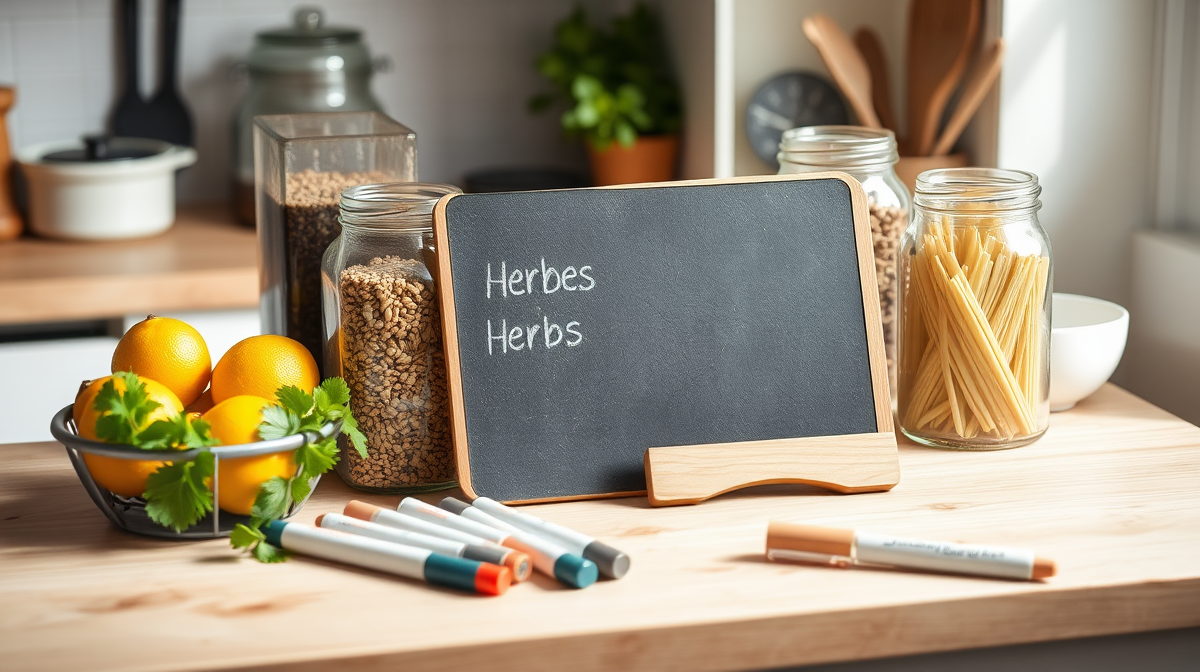
Not all markers are equal, and this is what truly matters when they touch food or surfaces going into the fridge. First, always look for the «food-safe» or «food-contact compatible» label, often indicated by a cup and fork symbol. Whiteboard markers usually carry water or alcohol-based ink, which dries quickly and doesn’t stain. Avoid coarse felt tips if you’re writing on small or curved surfaces; a fine or extra-fine tip gives you much more precision. If your kitchen is very humid or jars are washed daily, opt for «waterproof» or «permanent for food surfaces» versions, which resist microwave steam and gentle washing. I always keep two in my utility drawer: one black for chalkboards and one red for critical dates (dairy, meat, fish). The golden rule is to test them on an empty plate or jar before using them on actual products; if the ink bleeds or leaves a sticky residue, discard them.
Chalkboards and Supports: Magnets, Clips, and Sheets
The chalkboard is your canvas, but the support defines its utility. Rectangular magnetic chalkboards (10x15 cm or 15x20 cm) are ideal for the fridge door: they attach with a magnet and allow rewriting every morning. They come in painted metal, enamel, or glass, and all work with whiteboard markers. For jars and bottles, silicone clip chalkboards or washable adhesive sheets are the solution. They stick to the glass or plastic, are written on with a food-safe marker, and cleaned with a damp cloth. If you prefer not to adhere anything, tension-grip holders with elastic bands fit around jar openings and keep the chalkboard in sight. The important thing is that the system is rigid yet lightweight, and doesn’t take up useful space inside the fridge.
How to Label Without Confusing Expiration and Best Before
A common mistake is writing only the day. Always note the full date: day/month/year. If you use colors, establish an internal code: green for best before (longer shelf life), orange for expiration (consume immediately), red for opened items that preserve for less time. Write the exact content: «homemade strawberry jam» is not the same as «jam». For leftovers, note the preparation date and the estimated consumption date. This clarity prevents you from mixing up dates and ending up throwing away something that’s still at its peak. Moreover, by having the date visible, your brain stops mentally calculating and starts acting: you eat what’s closest to expiring, plan better, and stop buying what you already have at home.
Maintenance and Cleaning of the Materials
For the system to last, the materials must be cared for. Whiteboard markers dry out quickly if left uncapped for more than two hours; always store them with the cap tightly closed, and if one dries, try it on parchment paper by pressing gently until flow returns. Magnetic chalkboards are cleaned with a dry microfiber cloth or slightly dampened with diluted vinegar; avoid abrasive products that scratch the surface and make writing difficult. Silicone clips and adhesive sheets can accumulate grease over time; remove the clips and wash them with warm water and mild dish soap once a month. If you use adhesive sheets in the fridge, remove them carefully every six months and clean them with 70% isopropyl alcohol to remove adhesive residue without damaging the glass.
Integrating Labeling into Your 5-Minute Routine
The system only works if it’s part of the flow, not an add-on. I apply it in two moments: when returning products to the pantry and when storing leftovers. When I get home from the supermarket, I open the box, place the magnetic chalkboard on the fridge, note what expires soon, and move it to the front. For leftovers, I use a clear jar, attach the clip chalkboard, and write immediately. If I don’t have a chalkboard handy, a piece of parchment paper and clean painter’s tape works as a temporary patch, but not as a solution. The key is keeping materials visible and accessible: a glass jar with markers, extra chalkboards, and clips in the next drawer. In two weeks, you’ll notice you stop surprising yourself with smudged dates and start managing your kitchen with precision. If you’re interested in learning more about organizing foods by conservation priorities, you can check out my guide on the FIFO system for home pantries or the tray trick for organizing the week’s dinners.
Sources
- AESAN (Spanish Agency for Food Safety and Nutrition): Guidelines on food labeling and home storage safety.
- WHO (World Health Organization): Guidelines on food safety and the importance of accurate date marking in household kitchens.
- #organizacion-cocina
- #etiquetado-alimentos
- #utensilios-cocina
- #ahorro-comida
- #nevera-ordenada