
Why clutter steals your time (and safety)
Cooking should never feel like a race against the clock or an exercise in juggling dirty plates and stacked ingredients. When your countertop turns into a battlefield of cutting boards, pans, open bags of vegetables, and scattered jars, your brain quickly gets overloaded. And when your mind is overloaded, mistakes multiply: you over-salt, you burn the onion base, or worse, you cross-contaminate raw chicken juices onto your salad. Clutter isn’t just an aesthetic issue or a social media trend; it’s a real food safety hazard and a productivity killer. At home, through Umami Cook, I learned that taking back control starts with understanding that kitchens aren’t organized by shelves or color codes, but by workflow. When you remove physical friction, cooking stops being a maze and becomes a logical circuit.
Practical zoning: from the sink to the counter
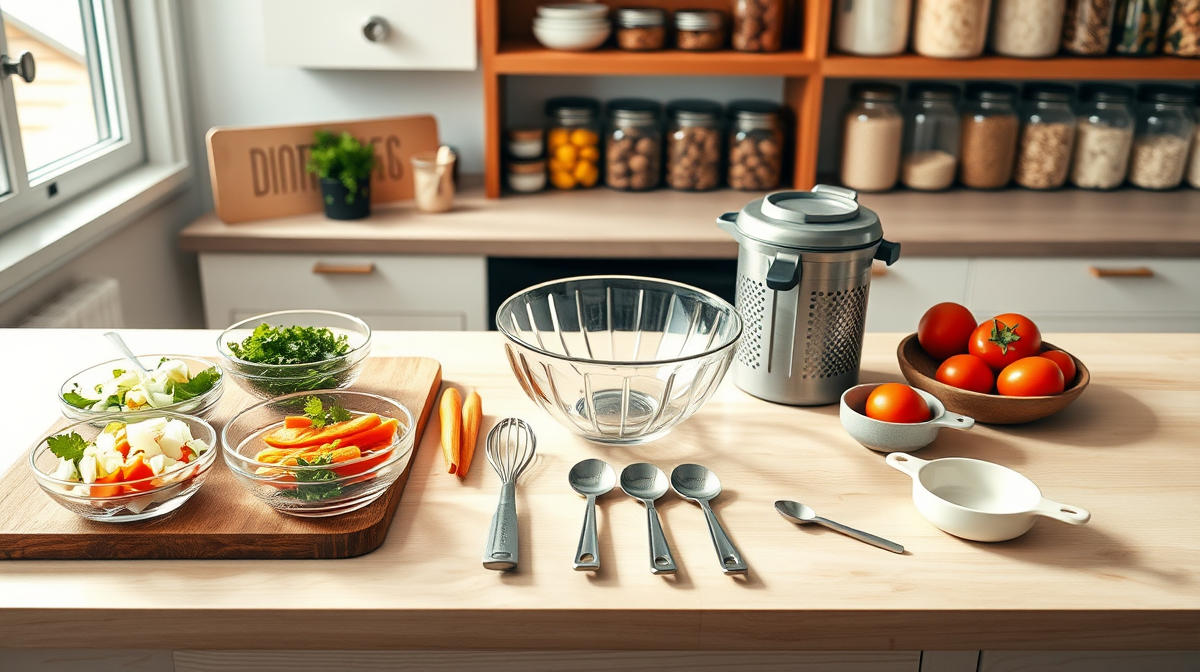
Imagine your kitchen divided into three invisible strips that you move through without circling around. The first is the prep zone, right where you have the most open space and good lighting. This is where mise en place lives: everything you’ll use in the next twenty minutes should be peeled, chopped, measured, and placed in low bowls before you even turn on the stove. The second strip is the cooking zone, where burners, pans, wooden spoons, and direct-handling tools live. The third is the washing and maintenance zone, tucked next to the sink and trash bin. The usual mistake is mixing these zones randomly. If you chop tomatoes to the left of the sink and sauté onions to the right, you’re creating an unnecessary loop that wastes steps and energy. Move your scale, knives, and mixing bowls to the prep zone. Keep the cooking zone strictly for anything that touches heat. And keep the washing zone strictly for dirty items or for rinsing what you just used. This mental and physical separation drastically reduces collisions, dropped utensils, and unnecessary movement.
Parallel processing: the secret to faster evenings
Most recipes are taught as a straight line: step one, step two, step three. But in real life, time is a circular, overlapping resource. Learning to process in parallel is what gives you hours back without needing to spend your Sunday doing full meal prep. This isn’t about making three stews at once; it’s about identifying tasks that don’t compete and running them simultaneously. While the onion is sweating over medium heat, you can mince the garlic and prepare broth with hot water. While the rice is absorbing liquid, you can wash and spin lettuce, whisk the dressing, or chop nuts. The golden rule is the three-item limit: never handle more than three active elements at once in your prep zone. If you run out of space, lower the heat or shift the pan to a warm burner. Technical patience saves more dinners than rushing does. Plus, this method lets you adjust to interruptions: if the phone rings or someone walks in, you only have to drop the heat and leave ingredients exactly where they are. Nothing burns, nothing spills, and nothing gets mixed up by accident.
Real-time cleaning: the habit that changes everything
The myth of “clean at the end” is the main source of kitchen stress and the number one enemy of efficiency. Cleaning while cooking doesn’t require a two-hour routine or specialty products; it’s about thirty-second micro-habits that become automatic. The knife you just used goes straight into the sink, not into a dish graveyard. The mixing bowl gets rinsed with a quick stream of water while the next ingredient drains. The counter edges get wiped with a microfiber cloth or damp sponge every time you switch food groups. This technique, known as clean-as-you-go, prevents the mountain of dishes from growing and turns cleanup into a natural extension of cooking. By the time you finish, you’ll only be left with larger tools, the heavy-bottomed pan, and the counter. And yes, it works even with young kids: handing them a damp cloth to wipe the edge while you stir the pot is a practical lesson in organization that teaches responsibility without pressure.
Adapting the system to your actual rhythm
You don’t need a magazine-perfect kitchen to apply this. If your space is tight, use a large board as a mobile island and store it away when done. If your lighting is poor, install an LED strip under upper cabinets; seeing clearly reduces mistakes and speeds up flow. Most importantly, stop trying to cook like you’re in a formal class. Real home cooking adapts to absorption times, dishwasher loads, and the life that walks through the door. Organize by flow, not by aesthetics. When your kitchen flows, food stops being a chore and becomes the calm center of your day. To keep this system running long-term, check out our guide on the FIFO pantry system and this post on cutting household waste. Order isn’t maintained by willpower; it’s built through routines that actually fit your reality.
Sources
- Agency for Food Safety and Nutrition (AESAN). Guide to good hygienic practices in household food handling.
- World Health Organization (WHO). Five Keys to Safer Food Manual: safe preparation and handling.
- #organizacion-cocina
- #flujo-trabajo
- #mise-en-place-casera
- #cocina-diaria